Search


  Advanced Search
 
Popular Authors
 
 »  Home  »  Pumps  »  Advantages of a Constant Pressure Pumping System
Advantages of a Constant Pressure Pumping System
By Bill Lillich | Published  02/13/2007 | Pumps | Rating:
Advantages of the constant pressure pump system

Over the past decade the smaller pump end user has gained the advantages of the constant pressure pump system. Constant pressure systems were generally used in larger commercial systems requiring expense control panels and three phase electricity was required. Through advances in technology costs have been reduced and three phase electricity is not always required. Although there are different manufactures of constant pressure water systems, the basic principle behind each is the same. 


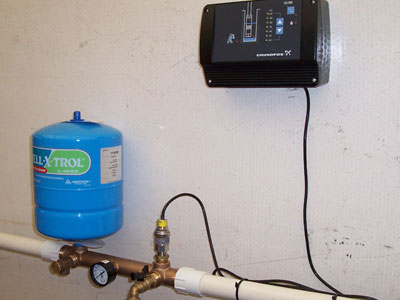
A special pressure switch (Franklin Pump Systems) or pressure sensor (Grundfos) is connected between the pressure tank and water load (shower, sprinkler etc).  A signal is sent to the Variable Frequency Drive (VFD).  The VFD reads this signal and through the programming in the VFD, the AC input power is converted to DC power to drive the motor and vary the frequency therefore changing the speed of the motor and pump.  This allows the pump to run only as fast as necessary to maintain constant pressure.


A standard pumping system consists of a pump and motor, pressure switch, pressure tank and control box.  Let’s assume a 30-50 psig pressure switch and a 20 gallon pressure tank is installed in our system.  We live in a two story house with a shower upstairs.  The pump system is installed in the basement at the opposite end of the house. As you start your shower, the water pressure is great but after a few minutes the pressure goes down to the point where you are ready to scream.  This happens because the well pump will not start until the pressure at the switch drops down to 30 psig.  The pressure in your shower will be less than that due to friction loss and head loss in the piping. 


A constant pressure system prevents the above from happening.  Here is how it does it.

A constant pressure system varies the frequency (speed) of the well pump to maintain a set pressure.  If your system is set to operate at 50 psig, then the pump will speed up or slow down as necessary to maintain the set pressure as the water demand increases or decreases.


Although there are different manufacturers of constant pressure water systems, the basic principle behind each is the same. A pump is selected based on the peak usage.  For example, the most water you will use at any one time is to operate your irrigation system for your yard.  You have 10 sprinkler heads that use 2 gpm each at 40 psig.  Therefore you need a pump that will supply you with 20 gpm at 40 psig.  Your pump installer will choose a pump that will supply you with 20 gpm for the desired system pressure and pump depth setting.  Since you will have friction loss due to the pipe diameter and length of the pipe to each sprinkler head, we set your system pressure for 50 psig.  Instead of a 20 gallon pressure tank, you can now use a tank as small as a 4 gallon tank. 


Now as you start your shower, the special pressure transducer or switch will sense as low as a .25 psig drop in pressure and send a signal to the VFD controller to start your pump at a reduced frequency.  This is what is known as a “soft start”.  The pump will then ramp up to the speed that is required to maintain the 50 psig.  The pump will speed up and slow down (hunt) to find the optimum speed.


While in the shower, a family member decides to start a load in the washing machine.  Your constant pressure system will quickly sense the pressure drop and speed the pump up to hold the 50 psig in the system.  The only change you will see is a temperature change.  The pressure drop you see with the standard system is now non-existent.

Whether you are building a new house or upgrading an old house, if your water supply comes from a well, then a Constant Pressure Pump System is what you should be installing.  Some of the benefits include:


* Longer motor life - the motor is not starting or running at full speed at all times.


* Smaller water tank – gives you more space in your basement or wherever your system is installed.


* Easier troubleshooting – pumps controls let the technician know why the pump tripped or stopped running.  This means less time therefore less money troubleshooting a system.


* Some systems provide additional features like motor protection, soft start, etc.


* And the best benefit – constant pressure.


Other uses for a Constant Pressure Pumping System are irrigation systems, livestock feeding, water treatment and geothermal systems or anytime constant pressure is desired.


Two of the more popular systems are made by the manufacturers Grundfos and Franklin Electric (Franklin Pump Systems, FPS).


Grundfos has a 3” line of pumps called the SQE (Smart Flo) pumps.  They range in flows from 5 gpm to 30 gpm and depths from 90 feet to 700 feet.  They use two wires plus ground motors and have some that operate off of 115VAC.  By only using two wires, the cost of the drop wire and the wire from the controls to the motor are less expensive.  The SQE line of pumps is ideal for situations where you have a 3” diameter well. Grundfos’s 4” line of constant pressure pumps are designed to be used with either a 3hp or 5hp motor.  The constant pressure VFD is configured and optimized for the Grundfos pump and motors.  The pump line ranges from a 16 gpm to 75 gpm Grundfos pump end. Both Grundfos Constant Pressure Pump Systems are designed to be used with a two gallon pressure tank.


The other manufacturer, Franklin Pumps Systems (FPS) does not offer a 3” line of pumps.  However, they offer an alternative that Grundfos does not. A Franklin Pumps Systems produces a VFD that can be used on existing systems that have a ½, ¾, 1, 1 ½ or 2hp, 230V, single phase, 3-wire plus ground motors (black, red, yellow and green wires). Be careful, three phase motors have the same color code, so you must be sure its single phase electricity. Next remove your current pressure switch and control box and replace it with the MonoDrive or MonoDrive XT and the special pressure switch.  You may also replace your current pressure tank with a smaller tank, either 4 or 8 gallon tank, depending on the flow that you are looking for. If you are doing a complete pump systems replacement and are looking for higher flows, FPS offers a VFD called a SubDrive for use with a 1 ½, 3 or 5hp, 230V, 3 phase, 3-wire plus ground motor.  The FPS Constant Pressure System allows you to use any manufacturers pump ends, but must be used with Franklin Electric motors. 


Bill Lillich

Field Tech Supervisor/Pump Sales

Environmental Equipment & Supply

How would you rate the quality of this article?
1 2 3 4 5
Poor Excellent

Verification:
Enter the security code shown below:
img


Add comment
Comments